
 How-to
7 Luxury Real Estate Valuation Methods That Hold Up
Last Updated: October 28, 2026
Quick Summary
Luxury real estate valuation is the process of estimating what a high-end property would sell for under fair market conditions, and it rarely fits standard formulas because custom estates often have no true comps. A sound luxury real estate valuation relies on several data points, not one, and typically pairs a primary method with a cross-check.
- Pricing off a single distant sale is the most common luxury mistake, since one outlier can swing value widely.
- When recent sales are scarce, look back 12 to 24 months and apply a market-conditions adjustment.
- The income approach divides net operating income by the capitalization rate to produce value.
- The cost approach estimates rebuild cost today minus depreciation, plus land value, as a floor or sanity check.
- A tight range within 5% signals strong comparable support; a wide range signals an unusual property or thin market.
Table of Contents
- Why Standard Valuation Methods Fall Short on Luxury Homes
- Method 1: The Sales Comparison Approach and Comparable Sales for Luxury Homes
- Method 2: The Income Capitalization Approach for Luxury Investment Properties
- Method 3: The Cost Approach and Replacement Cost for Complex Properties
- How to Run a Luxury Home Comparative Market Analysis
- Price Per Square Foot for Luxury Homes: Useful Signal, Dangerous Shortcut
- Your Luxury Home Appraisal Checklist: What Appraisers and Buyers Examine
- Choosing the Right Valuation Method for Your Property
- Frequently Asked Questions
Why Standard Valuation Methods Fall Short on Luxury Homes
Luxury real estate valuation is the process of estimating what a high-end property would sell for under fair market conditions, and it rarely fits the standard formulas.
That gap is the whole problem. Lenders and appraisers rely on recent sales of similar homes, but luxury inventory turns over slowly. When a property has no true comps, the numbers get soft fast.
The Thin-Market Problem: When There Are No True Comps
A thin market means few sales and few buyers for a given property type. In practice, that means the three "comparable" homes an appraiser finds may differ in size, view, or age by a wide margin.
Watch out: pricing off a single distant sale is the most common luxury mistake. One outlier can drag a valuation up or down by a wide margin.
Unique Features, Provenance, and Buyer Pool Segmentation
Provenance is the documented history of a property, including who owned it and its design pedigree. A home designed by a noted architect or tied to a famous former owner can carry value that no square-footage formula captures.
Buyer pool segmentation matters just as much. A property built for one specific taste may appeal to a narrow group of buyers. That smaller pool changes both the price and the time it takes to sell.
Method 1: The Sales Comparison Approach and Comparable Sales for Luxury Homes
The sales comparison approach estimates value by adjusting recent sales of similar properties to match the subject home. It is the most common method for residential real estate, and it still anchors most luxury valuations, but in the luxury segment the work is in the sourcing and the adjustments, not the formula.
Here is how it works in practice:
- Find recent sales of homes with similar size, view, and finish level.
- Adjust each sale up or down for differences.
- Weight the closest comps most heavily.
The challenge is finding comps that truly compare. A water-view estate and an inland estate of the same square footage are not the same product. Adjustments for location, view, and condition do most of the work.
Sourcing Comps in a Thin or Off-Market Luxury Market
Luxury inventory turns over slowly, so the three nearest sales may be months old and materially different from the subject. Most practitioners expand the search in three directions:
- Geography: widen the radius until you find homes of the same product type (waterfront, view, gated, equestrian) rather than the same ZIP code.
- Time: look back 12 to 24 months when recent sales are scarce, then apply a market-conditions adjustment for the change in prices since the sale date.
- Transaction type: include verified private and off-market sales when they can be confirmed. Public records and multiple listing data miss many high-end transfers, so a credible analysis documents how each private sale was verified.
A common pattern is to weight the closest comps most heavily and disclose the weaker ones as secondary support. That transparency is what separates a defensible luxury valuation from a guess.
A Worked Adjustment Example
Adjustments are where the analysis lives or dies. The table below shows a simplified, illustrative adjustment grid for a hypothetical waterfront estate, the numbers are for demonstration, not a market quote.
| Line item | Comparable sale | Adjustment | Adjusted value |
|---|---|---|---|
| Sale price | $4,200,000 | , | , |
| Market conditions (sold 14 months ago; prices up ~4%) | , | +$168,000 | $4,368,000 |
| Living area (comp 400 sq ft smaller) | , | +$200,000 | $4,568,000 |
| View (comp is partial water view; subject is full) | , | +$250,000 | $4,818,000 |
| Lot (comp is smaller and less private) | , | +$150,000 | $4,968,000 |
| Condition (comp recently renovated; subject is dated) | , | −$300,000 | $4,668,000 |
| Pool and outdoor living (subject superior) | , | +$100,000 | $4,768,000 |
| Indicated value | ~$4.77M |
Run the same grid on three to five comps, weight the most similar ones, and you get a range rather than a point. If the adjusted values cluster between $4.6M and $4.9M, that range is the defensible conclusion; a single number implies precision the data rarely supports.
Communicating a Confidence Range
Because luxury comps are sparse and homes are highly customized, the honest output of a sales comparison is a range with a stated confidence level. Discerning how specific luxury custom home features influence these valuation swings provides the necessary context to distinguish between genuine architectural value and mere aesthetic preference.
Comparable sales for luxury homes often require looking further back in time and further out in geography. That adds uncertainty, so a good analysis shows its work. For actual neighborhood figures to ground the discussion, see Dana Point neighborhood values.
Method 2: The Income Capitalization Approach for Luxury Investment Properties
The income approach values a property by the income it produces, using a capitalization rate to convert net operating income into value.
The formula is simple: net operating income divided by the capitalization rate equals value. If a property generates steady rental income, this method gives a clean, defensible number.
But most luxury homes are not pure income plays. A coastal estate may rent for part of the year and sit empty otherwise.
Method 3: The Cost Approach and Replacement Cost for Complex Properties
The cost approach estimates value as the cost to rebuild the property today, minus depreciation, plus land value. It shines for complex properties where no comparable sales exist.
Replacement cost means what it would take to build a similar home at current prices, including materials and labor.
The catch: the cost approach ignores what buyers will actually pay. A home can cost a great deal to rebuild and still sell for less if the market does not value those features.
How to Run a Luxury Home Comparative Market Analysis
A luxury home comparative market analysis is a side-by-side review of recent sales and active listings to estimate a realistic price range. It is the working tool behind any credible luxury real estate valuation.
Here is a checklist for running one well:
- Pull recent sales from the last 6 to 12 months.
- Note active and pending listings to gauge competition.
- Adjust each comp for view, lot, condition, and finish.
A market analysis is only as good as its inputs.
Price Per Square Foot for Luxury Homes: Useful Signal, Dangerous Shortcut
Price per square foot is a quick ratio: sale price divided by living area. It is a useful starting signal, but a dangerous shortcut for luxury homes.
Why? Two homes of equal size can differ wildly in value based on view, lot, and finish.
Use price per square foot as a check, not a conclusion. When the number looks far off the neighborhood norm, ask why before you trust it.
Your Luxury Home Appraisal Checklist: What Appraisers and Buyers Examine
A luxury home appraisal checklist covers the features that drive value beyond raw size. Appraisers and serious buyers look at the same core items.
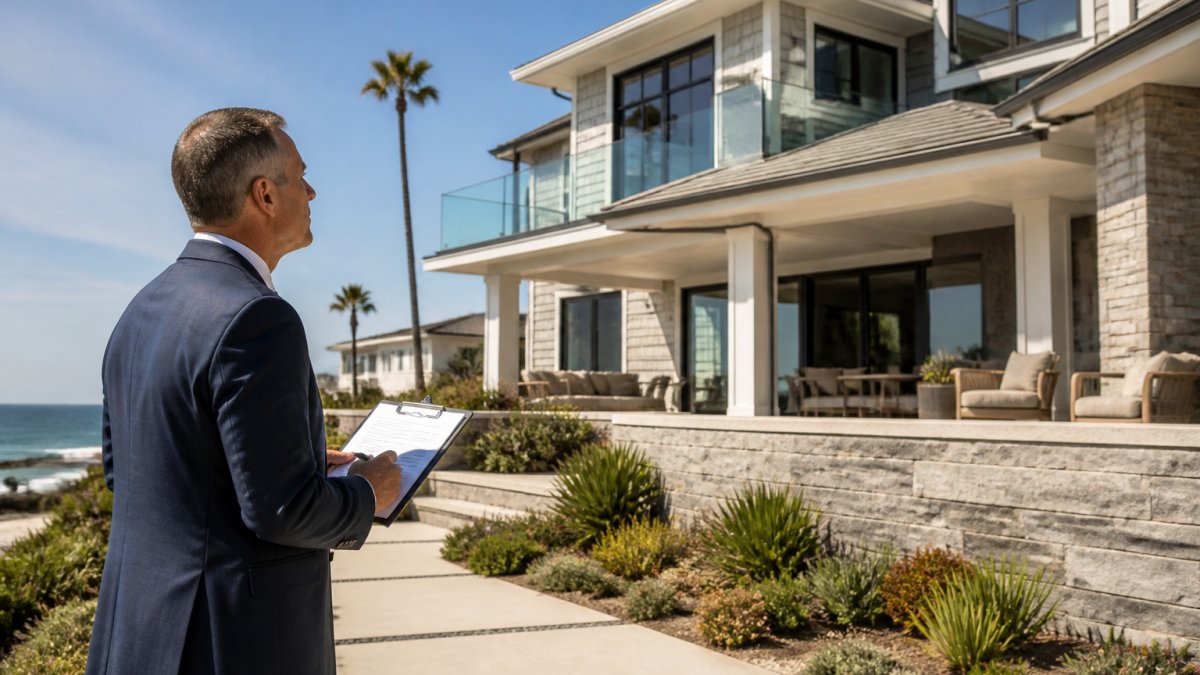
Here is what they examine:
- Property condition: finishes, maintenance, and age of key systems.
- Location and neighborhood: views, privacy, and lot position.
- Unique features: pools, guest houses, smart features, and custom design.
Each item feeds the adjustments in a comparable sales analysis. A home that scores well on all five supports a stronger value.
Choosing the Right Valuation Method for Your Property
Choosing a valuation method comes down to two things: the property and the purpose. There is no single right answer for every luxury home, and the purpose often decides the method before the property does.
Match the Method to the Purpose
| Purpose | Primary method | What it is for |
|---|---|---|
| Sale or listing price | Sales comparison, cross-checked with cost | What a buyer will pay in the open market |
| Lending appraisal | Sales comparison (required by most lenders) | Collateral value for a mortgage |
| Tax or estate valuation | Sales comparison, sometimes cost | Defensible value for tax authorities and estate planning |
| Insurance replacement cost | Cost approach | What it would take to rebuild, not what it would sell for |
| Investment value | Income capitalization | Value to a specific investor based on rental income |
A home can carry several different values at once. An estate worth $5M on the open market may have a $6M replacement cost for insurance and a $4.5M investment value to a rental buyer. None of those numbers is wrong, they answer different questions.
When to Bring in a Credentialed Appraiser
For lending, tax, estate, and litigation purposes, most lenders and authorities expect a credentialed appraiser, typically a state-certified or state-licensed appraiser, and for complex luxury assignments often one holding the Appraisal Institute's MAI or SRA designation. A real estate agent's comparative market analysis is a pricing tool, not an appraisal, and should not be presented as one. Knowing the difference protects the client and keeps the transaction clean.
Reconciling Divergent Results
A combined approach is often the safest. Run two methods and compare the results. If they land close, confidence is high. If they diverge, dig into why before you set a price. Common reasons for divergence:
- The cost approach is high because the home is highly customized, but buyers do not pay full replacement cost for bespoke features.
- The income approach is low because the property is a lifestyle purchase, not a rental.
- The sales comparison is wide because comps are thin or off-market.
In each case, the divergence itself is information. It tells you which assumptions are driving the number and where the valuation is most sensitive.
A Practical Decision Sequence
- State the purpose of the valuation.
- Identify the property type and how many true comps exist.
- Choose a primary method and a cross-check method.
- Run both, compare, and explain any gap.
- Present a range with the assumptions and confidence level stated.
That sequence keeps the method tied to the purpose and makes the final number defensible to a buyer, a lender, or a tax authority.
Frequently Asked Questions
How is a luxury home valued when there are few comparable sales?
Appraisers and agents widen the search radius and time window, then adjust for differences in location, view, condition, and amenities. They may also weigh the cost approach and, for income-producing properties, the income approach. In thin markets, a confidence range is more honest than a single number. A luxury real estate valuation should document every adjustment so you can see why one property is priced above another.
Is price per square foot a reliable way to value a luxury home?
It is a starting signal, not a verdict. Price per square foot for luxury homes swings widely with view, lot size, privacy, and finish level. Use it to spot outliers, then confirm with a full comparative market analysis that accounts for unique features and buyer demand.
What is the difference between a real estate appraisal and a comparative market analysis?
A comparative market analysis is an agent's pricing analysis based on recent sales, active listings, and market conditions. Both inform a luxury real estate valuation.
What makes luxury real estate harder to appraise?
Thin sales volume, unique amenities, and a narrow buyer pool all complicate the work. A custom home with provenance or rare features may have no direct comps. Location, neighborhood, and market conditions also matter.